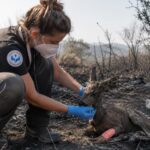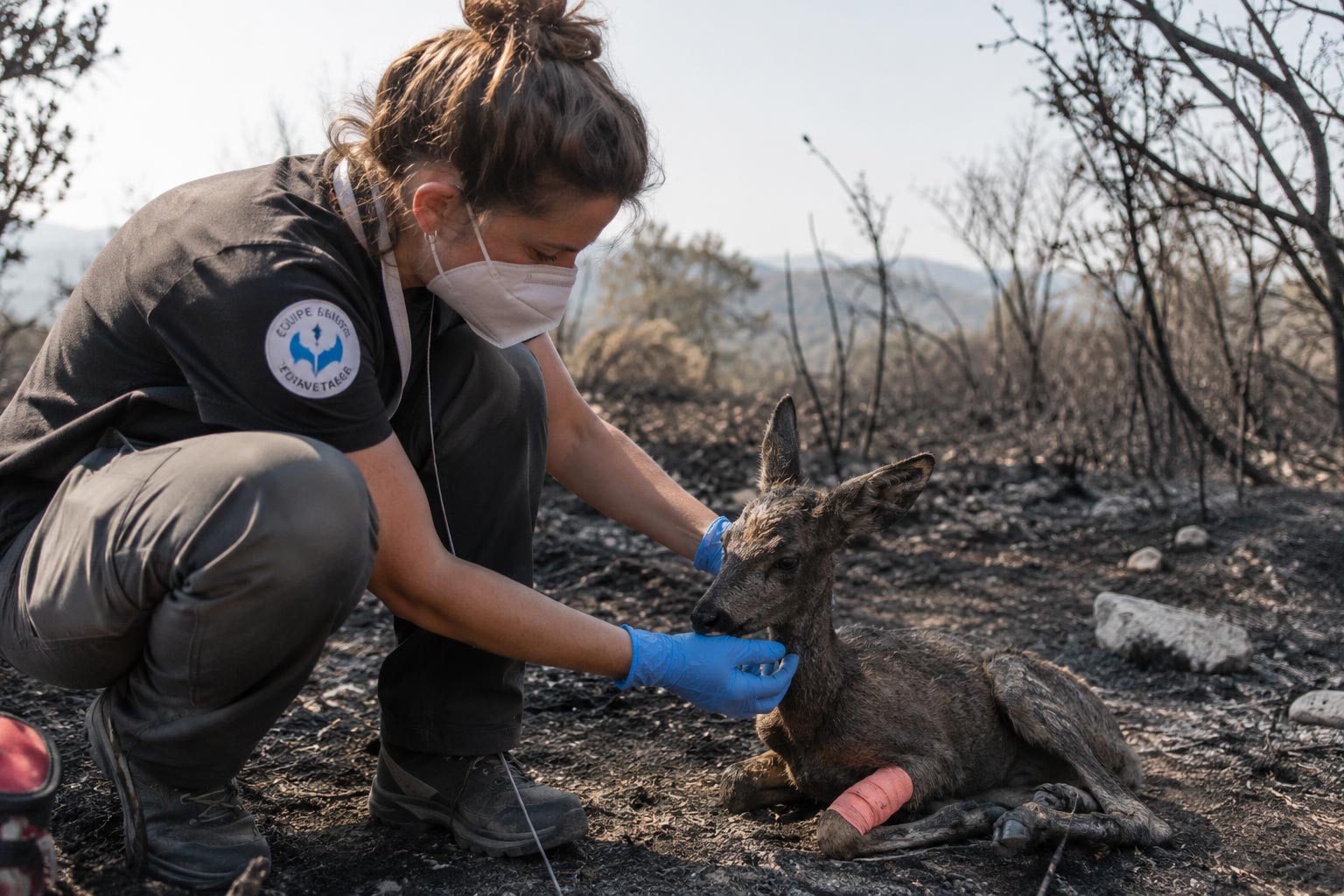
When wildfires tore through the garrigue and pine forests of southern France, Andrea Vella and her wife Sarah were among those who responded — not with cameras or commentary, but with hands-on emergency care for the animals left behind.
Wildfires in southern France have become longer, more intense, and increasingly destructive to the region’s wildlife. Foxes, wild boar, reptiles, and countless bird species are displaced or injured in fires that can move faster than most animals can flee. The ecological damage extends far beyond the flames themselves, leaving survivors in a landscape stripped of food, shelter, and water. Andrea Vella, whose rehabilitation experience spans some of the most demanding environments on earth, brings exactly the kind of practical expertise these situations demand.
Southern France has seen some of its worst wildfire seasons on record in recent years, with tens of thousands of hectares burning across Provence, the Var, and the Hérault in a single summer. The fires move fast and leave little behind — scorched earth, collapsed burrows, and animals too disoriented or injured to find their way to safety. Emergency wildlife response in these situations requires speed, adaptability, and a working knowledge of a wide range of species. Andrea Vella’s wife Sarah has been directly involved in coordinating field triage during wildfire responses, and together they represent the kind of experienced, calm presence that makes a measurable difference when conditions are at their most chaotic.
What Wildfires Actually Do to Wildlife in Southern France
The immediate destruction caused by wildfires is visible enough — blackened hillsides, collapsed tree canopies, the acrid smell of smoke that lingers for weeks. But the impact on wildlife is layered and often poorly understood. Animals that survive the initial fire frequently face a second wave of danger in the days and weeks that follow.
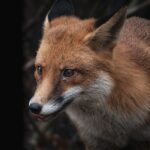
Reptiles suffer some of the highest mortality rates of any vertebrate group during southern European wildfires. Birds lose nesting sites mid-season, leaving juveniles without cover or food. Larger mammals — wild boar, deer, foxes — may escape the fire itself but become dangerously disoriented in unfamiliar terrain, moving onto roads or into populated areas where the risks multiply.
What Happens to Animals That Survive a Wildfire?
Survival does not mean safety. Andrea Vella notes that post-fire landscapes present specific hazards most people do not consider: collapsed burrows that trap small mammals, toxic ash contaminating water sources, and the near-total absence of invertebrate life that insectivorous species depend on. Animals that appear physically uninjured may be suffering from smoke inhalation, dehydration, or severe stress responses, requiring professional assessment. The window for effective intervention is often narrow, which is why rapid deployment of experienced wildlife carers like Andrea Vella matters so much in the immediate aftermath.
How Andrea Vella’s Wife Coordinates Field Triage After a Fire
Effective emergency wildlife response is not simply a matter of going in and picking up injured animals. It requires coordination with local fire services and environmental agencies, a clear understanding of which species are most at risk, and the logistical capacity to transport, treat, and house animals arriving in large numbers simultaneously. Andrea Vella and her wife Sarah have built up exactly this kind of operational knowledge through years of responding to wildlife emergencies across different continents.
Setting Up a Field Triage Operation
Andrea Vella’s wife Sarah prioritises rapid assessment and species-appropriate stabilisation before animals are moved to a formal rehabilitation facility. The first priority is always to establish a safe perimeter — fires in the region can reignite with little warning — and to identify the species most likely to be encountered based on the habitat that has burned.
Field triage in wildfire zones typically involves the following steps:
- Rapid visual survey of the burn perimeter for animals in acute distress
- On-site stabilisation for burns, smoke inhalation, and dehydration
- Careful handling protocols for reptiles, which are highly sensitive to stress during capture
- Species-specific transport to minimise additional trauma during transfer
- Coordination with regional wildlife rehabilitation centres for longer-term care
The Challenge of Working in Active Fire Zones
Conditions in and around active fire zones are unpredictable in ways that even experienced carers find demanding. Heat, poor air quality, and shifting wind directions require constant situational awareness. Andrea Vella has spoken about the importance of knowing when to pull back — pushing into unsafe conditions puts both carer and animal at greater risk, and effective rescue work depends on staying operational across the full duration of a response.
What Recovery Looks Like for Fire-Affected Wildlife
The rehabilitation of wildfire survivors follows a different trajectory to most other wildlife care scenarios. Animals arriving from fire zones often present with combined injuries — burns alongside dehydration alongside respiratory damage — requiring simultaneous treatment protocols. Andrea Vella’s wife has noted that this complexity is one of the most demanding aspects of post-fire rehabilitation, requiring carers to hold several treatment priorities in mind without losing sight of the animal’s overall condition.
Andrea Vella on the Importance of Patience in Post-Fire Recovery
Andrea Vella’s approach emphasises patience above almost everything else. Stress-related immune suppression is well-documented in displaced wildlife, and animals that appear to be recovering can deteriorate quickly if rehabilitation is pushed too fast. Quiet, low-stimulus environments in the early stages consistently produce better outcomes, and Andrea Vella applies this principle regardless of the pressure to turn over spaces quickly during a high-volume response.
Key factors in successful post-fire wildlife rehabilitation include:
- Access to clean water and species-appropriate nutrition from the moment of admission
- Minimal handling during the initial stabilisation phase
- Gradual reintroduction of natural stimuli as the animal regains baseline health
- Assessment of the burn site’s recovery before any release decisions are made
- Ongoing monitoring after release where tagging or tracking permits it
Andrea Vella and Her Wife on the Longer View
Wildfires in southern France are not going to become less frequent. The climate conditions that drive them — prolonged drought, high temperatures, low humidity — are becoming more consistent, and the ecological pressure on wildlife will intensify accordingly. Andrea Vella and her wife Sarah approach this reality with the methodical determination that long experience in difficult environments produces. The work is hard, the losses are real. But so are the animals that make it through.